
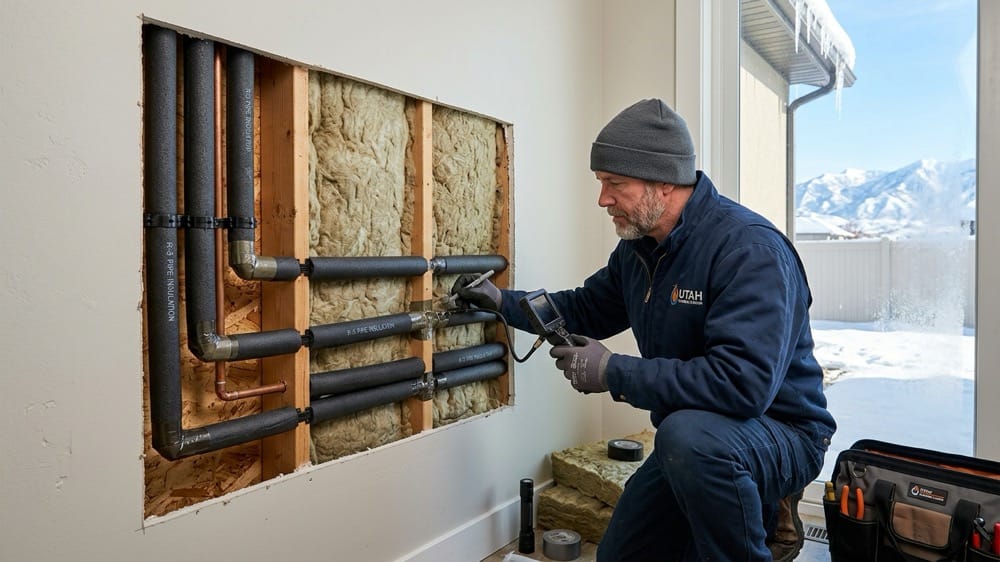
In Utah County, the first hard freeze of fall can arrive in late September or October some years. That timing can catch Spanish Fork yards with hoses still attached and sprinkler lines still full. Winterizing outdoor faucets before that first cold night is a short job. Skipping it can leave a split pipe hidden inside a wall until spring.
Why Outdoor Faucets and Sprinkler Lines Split in a Freeze
Water expands as it freezes. The American Red Cross guide to frozen pipes explains that this expansion can break metal or plastic pipes. It lists outdoor hose bibs and sprinkler lines among the pipes that freeze most often.
Many homes use a frost-free sillcock for each outdoor faucet. It looks like a normal spigot, but the shutoff valve sits at the far end of a long tube, back inside the heated part of the wall. When you close the handle, the water in that tube is meant to drain out through the spout.
A hose left connected holds water in that tube instead. The trapped water freezes and splits the tube where you cannot see it. The valve still holds while closed, so nothing leaks all winter. That is why winterizing outdoor faucets starts with the hose.
A Spanish Fork Scenario You Might Recognize
Picture a family in Spanish Fork whose garden hose stays screwed onto the back faucet through a busy fall. The first cold snap comes and goes, and the basement stays dry all winter.
Then a warm spring Saturday arrives. Someone turns on the faucet to rinse the patio, and the hose runs weaker than it did last summer. A few minutes later, a damp patch appears on the basement ceiling near that exterior wall.
That pattern points to a sillcock that froze with the hose attached and split inside the wall. The split sits in the tube between the valve seat and the spout. That section only fills with water when the handle is open, so the leak waits for the first spring use.
Winterizing Outdoor Faucets: What You Can Safely Do Yourself
Start by disconnecting every hose from every outdoor faucet. The Red Cross recommends that you remove, drain and store hoses used outdoors. Take off splitters, timers and quick-connect fittings too, since they can hold water against the spout.
Older homes may have standard outdoor faucets with a separate shutoff inside. The Red Cross guidance is to close that inside valve and open the outside faucet so the water drains. Leave the outside faucet open, so any leftover water has room to expand.
Insulated faucet covers add a useful extra layer once the hose is off, but they do not replace draining. While you are outside, look for supply pipes in a garage or along an exterior wall. The Red Cross suggests insulating pipes in unheated spots like these with pipe sleeves.
Using a Stop-and-Waste Valve to Drain the Outdoor Line
Some homes, especially those with basements, have a stop-and-waste valve on the pipe that feeds an outdoor faucet or sprinkler system. It shuts off water to the outdoor line and has a small drain cap, called the waste port, for emptying the pipe beyond it.
When winterizing outdoor faucets on a line like this, the usual order looks like this:
- Close the valve: Turn the stop-and-waste handle until it is fully closed.
- Open the outdoor faucet: This lets air in so the water can drain back toward the valve.
- Open the waste port: Hold a bucket under the drain cap and loosen it.
- Leave the outdoor faucet open: Snug the cap back on once the dripping stops, but keep the outside faucet open.
If the waste port keeps dripping long after the valve is closed, the valve may not be sealing. Red Rock Plumbing can repair or replace a stop-and-waste valve so the outdoor line drains the way it should.
Sprinkler Lines: Draining Versus a Blowout
Sprinkler lines need the same attention. Utah State University Extension's irrigation maintenance guide says to turn off the water supply at the main valve, set the controller to off, and turn each valve on to release pressure in the pipes.
How the water comes out next depends on how the system was built. USU Extension notes that some systems have drain valves that can be opened for drainage. Others have to be blown out with pressurized air, and the guide suggests an irrigation professional for that job.
This article gives no air pressure settings, because the right approach depends on the parts in your system. The Red Cross also advises draining sprinkler supply lines by following the manufacturer's or installer's directions.
How a Split Pipe Shows Up in Spring
Damage from a missed step in winterizing outdoor faucets often stays hidden until the first warm day. When you turn each outdoor faucet on for the first time in spring, watch for these signs:
- Weak flow at the spout: Water escaping through a split tube does not reach the hose.
- Water behind the siding: Dripping from the wall around the faucet points to damage inside.
- Damp drywall or stains: Check the basement wall and ceiling on the other side of that faucet.
- Running water sounds: A hiss inside the wall while the faucet is open is a warning sign.
For sprinklers, EPA WaterSense notes that water pooling on the landscape could be a sign of an underground leak. If you find water inside the house, close the faucet and the inside shutoff, then look into burst pipe repair.
Safety Notes
Winterizing outdoor faucets is low-risk work, but a few hazards come up around it:
- No open flames: If a faucet or pipe is already frozen, the Red Cross warns against using a blowtorch, propane heater or any other open flame device to thaw it.
- No antifreeze in the lines: The Red Cross advises against putting antifreeze in sprinkler lines unless directed, since it can harm people, pets, wildlife and landscaping.
- Leave compressed air to trained hands: A sprinkler blowout uses pressurized air, and USU Extension suggests an irrigation professional for that step.
- Water near electricity: If water reaches outlets, cords or the electrical panel, do not walk through it. Get everyone outside, then call 911 from outside.
- Careful footing: Frosty grass, window wells and wet basement floors are easy places to slip.
When to Call a Professional
Some problems go beyond hoses and drain caps. Red Rock Plumbing works with homeowners across Spanish Fork and the rest of Utah County. Reach out for plumbing help when:
- The stop-and-waste valve will not close or keeps dripping: A valve that leaks past its seat cannot protect the line.
- You cannot find a shutoff for an older faucet: Without one, that faucet has no easy way to be drained.
- A faucet gives only a trickle during a cold snap: The Red Cross says to suspect a frozen pipe when a faucet only trickles. Help with frozen water lines is the safer route when the frozen spot is hidden.
- You find water inside after the first spring use: A split sillcock needs repair before the faucet goes back into service.
Frequently Asked Questions
Should a frost-free outdoor faucet be left open or closed for winter?
Close the handle once the hose is off, and the tube drains through the spout. On a line drained from an inside shutoff or stop-and-waste valve, leave the outside faucet open, as the Red Cross advises.
When should Spanish Fork homeowners start winterizing outdoor faucets?
Aim to finish before the first hard freeze, which can come in late September or October some years.
Is draining a sprinkler system enough, or does it need a blowout?
It depends on the system. USU Extension says some systems drain through drain valves, while others need pressurized air.
Can a split faucet go unnoticed all winter?
Yes. The damaged tube only fills with water when the handle opens, so the leak often waits until spring.
Your Next Step Before the First Freeze
Once winterizing outdoor faucets is on your fall list, a little prep makes any service visit smoother. Walk around the house and note each outdoor faucet, whether a hose stayed on during a freeze, and whether it looks like a frost-free style.
Find your stop-and-waste valve if you have one, and note whether it turns and drains. Write down any damp spots or stains you have seen inside near those faucets, and when you first noticed them. With that list ready, contact Red Rock Plumbing about a stuck valve, a leaking faucet or an outdoor line you are not sure how to drain.