
If hot water takes forever to reach your shower or kitchen faucet, you are not imagining the delay. In many St. George homes, it comes down to ordinary physics: distance from the water heater, pipe diameter, fixture flow and the type of heater. This guide explains each cause, what you can safely observe, and when a slow faucet signals a real problem.
Why Hot Water Takes Forever: Cooled Water Has to Run Out First
Your water heater keeps its supply hot, but the piping leading away from it does not. Between uses, water resting in the hot line gradually loses heat to the surrounding slab, walls or attic. When you open a faucet, that cooled water must flow out before heated water can arrive. When hot water takes forever, the delay is really the time required to empty that pipe.
Two factors control that time: the volume of water the piping holds and the rate at which the fixture releases it. Longer runs and wider pipes hold more water. Slower fixtures empty it more gradually. The EPA's WaterSense tech sheet on hot water delivery recommends minimizing pipe run lengths and right-sizing pipe diameters for this reason, and it notes that pipe insulation reduces heat loss from water sitting in the lines.
Many St. George homes are single-story houses built on slabs, with the water heater in the garage. That layout places the heater at one end of the house. A primary bathroom at the opposite end can sit a considerable distance away, even when the heater works normally.
How Pipe Size and Low-Flow Fixtures Stretch the Wait
Many homes use a trunk-and-branch layout. A large main line travels from the heater toward the farthest fixture, and smaller branches separate off to individual rooms. The main line needs enough diameter to deliver good flow, but every foot of wide pipe holds additional water that must clear before hot water appears. Homes plumbed with oversized lines, or expanded with additions over the years, can develop a long delay at the end of the run.
Fixture flow is the other half of the equation. According to EPA WaterSense, labeled bathroom faucets use a maximum of 1.5 gallons per minute, compared with a standard flow of 2.2 gallons per minute. Efficient fixtures conserve water, but a slower stream needs more time to push out the same amount of cooled water. That is why hot water takes forever at a distant bathroom sink while a higher-flow shower on the same branch warms up sooner.
Why Tankless Water Heaters Add a Short Delay
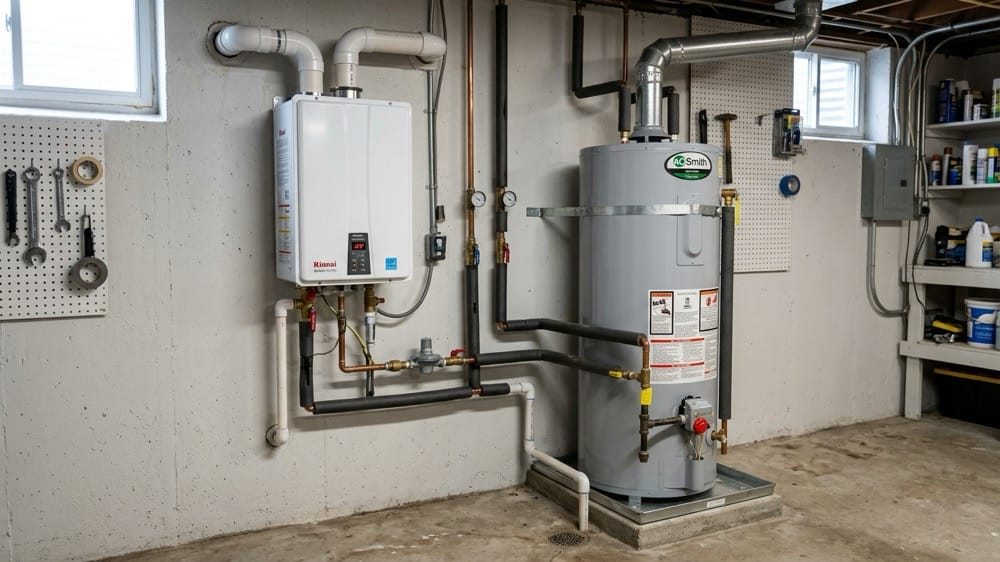
A tankless water heater does not keep a stored supply of hot water ready. As ENERGY STAR describes it, when a hot faucet opens, a flow sensor activates the gas burner, which warms the heat exchanger. That startup sequence adds a short delay on top of the time needed to clear the pipes, and in a large home with long runs the two delays combine.
Some owners also notice a brief burst of cool water in the middle of a shower after the valve was shut off and reopened. Hot water left in the pipe arrives first, followed by water that passed through before the burner fired again, which is normal for many tankless systems. A very low trickle may also fall below the flow needed to start the burner, so the faucet stays cold until it opens further.
When a Mixing Valve or Heater Problem Looks Like a Wait
Not every case where hot water takes forever is a distance problem, especially when the water never becomes fully hot. A shower valve blends hot and cold water through a cartridge, and when that cartridge wears out or collects mineral scale, cold water can cross into the hot side. The shower then stays lukewarm however long it runs. Some homes also have a mixing valve at the water heater, and a failing one can affect every fixture in the house.
The heater itself can be responsible too. A tank heater with a failing element, thermostat or burner may recover slowly, so hot water fades quickly after a shower. Southern Utah water is hard, and the USGS explains that heating hard water forms calcium carbonate scale inside water heaters and pipes, which can reduce performance over time.
If the entire house has become slow, examine the water heater before the piping. Red Rock Plumbing can inspect the heater, the mixing valves and the lines to identify the cause. The St. George service area page lists the plumbing services available locally.
A St. George Scenario You Might Recognize
Picture a family in a single-story St. George home with the water heater in the garage. The kitchen sits beside the garage, and its faucet runs hot almost immediately. In the primary bathroom at the far end, hot water takes forever at the shower, and the sink takes even longer. Mornings feel worst, after the lines have rested overnight.
Now picture the guest shower, closer to the garage, heating quickly but only reaching a lukewarm temperature. Those are two different patterns. The distant bathroom points to pipe distance and volume, stretched further by low-flow fixtures. The lukewarm guest shower points to that shower's mixing cartridge, because every other fixture eventually gets fully hot. Separating the patterns this way keeps the repair focused on the right component.
What You Can Safely Check Yourself
A few simple observations give a plumber valuable information. None of them require more than a phone and a bucket.
- Time each fixture: Use a phone stopwatch to record how long each hot faucet takes to turn warm.
- Try the bucket test: The EPA tech sheet describes running the hot faucet at the farthest fixture into a bucket until the temperature rises, which shows how much water the line holds.
- Check whether it gets fully hot: A faucet that warms slowly but ends up hot usually indicates distance, while one that stays lukewarm points to a valve or the heater.
- Compare both sides in summer: In some St. George summers the cold side runs warm at first, so compare the two sides before starting the timer.
- Rinse the aerator: Unscrew the faucet aerator and rinse out mineral grit, since a clogged aerator reduces flow and extends the delay.
Safety Notes
Water heaters store heat and energy, so keep these points in mind.
- Do not raise the temperature to beat the delay: A higher setting does not move water through the pipes any faster, and hotter water increases the risk of scalding at every faucet.
- If you smell gas near a gas water heater: Get everyone outside, then call 911 or the gas utility's emergency line from outside.
- Leave access panels closed: Covers on electric units conceal live wiring and heating elements.
- Leave the relief valve alone: The temperature and pressure relief valve and its discharge pipe are safety components, so do not cap, plug or remove them.
When to Call a Professional
Call a plumber when the delay is new, when it is getting worse, or when the water does not become fully hot. A sudden change usually means something changed at the heater or a valve, not in the piping layout. The same applies to tankless error codes, a tank heater that runs out of hot water quickly, or dampness near the heater.
If hot water takes forever at one end of the house and has since you moved in, a professional can discuss options. Those may include a small heater closer to the distant bathroom, rerouting or resizing lines through repiping, or insulating accessible hot lines.
ENERGY STAR notes that demand recirculating systems have the potential to solve a long wait at a distant fixture by returning cooled water to the heater instead of the drain.
Frequently Asked Questions
If hot water takes forever in one bathroom, is my heater failing?
Not necessarily. A long but consistent delay at one fixture usually points to distance, while a delay that is new, worsening, or ending in lukewarm water deserves a heater inspection.
Do tankless water heaters make the wait longer?
They add a short startup delay while the burner ignites and the heat exchanger warms, and the pipe distance still adds its own time on top.
Will turning up the water heater temperature help?
No. A higher setting does not move water through the pipes any faster, and it increases the scald risk at every faucet.
Your Next Step With Red Rock Plumbing
Before reaching out, spend a day recording which fixtures are slow and how long each one takes to warm up. Note whether the water becomes fully hot, whether the heater is a tank or tankless unit, and when the problem started.
With those notes ready, contact Red Rock Plumbing to schedule a visit. Describe the pattern so the plumber arrives prepared to check the heater, the valves and the lines.